
Nepal Takes AIIB Vice-Chair Role as Lender Eyes $20B Target
Nepal has assumed a vice-chair position at the Asian Infrastructure Investment Bank during its annual meeting in Doha, where Finance Minister Swarnim Wagle pressed for concessional loans and flood-reconstruction funding.
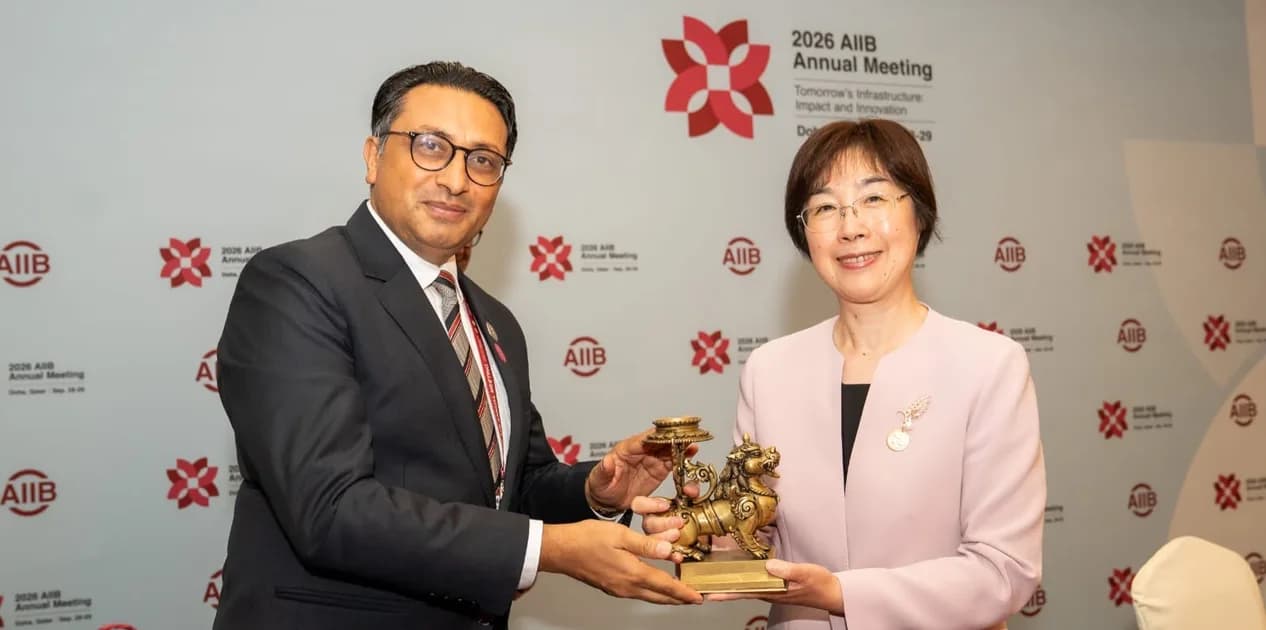
Nepal has been selected as a vice-chair of the Asian Infrastructure Investment Bank (AIIB) during the multilateral lender's 11th annual meeting of the Board of Governors in Doha, Qatar. Finance Minister Dr. Swarnim Wagle formally assumed the post on behalf of the country, while urging the institution to scale up concessional financing and assist in post-disaster rebuilding.
According to reports from Nepali news outlets Bizmandu and Ratopati, Nepal was chosen alongside Ireland to hold the vice-presidential position for the coming year under the bank's governance framework. Addressing the Governors' Business Roundtable on the second day of the summit, Dr. Wagle stressed that capital formation through infrastructure remains the primary engine of economic expansion for least-developed and developing countries. He urged the AIIB to tailor its funding terms to the economic realities of developing member states by offering deeply concessional rates and structuring financial packages to crowd in domestic and foreign private capital across transportation, electricity, and telecommunications.
Dr. Wagle also held bilateral talks on the sidelines with newly elected AIIB President Zou Jiayi, as reported by financial news outlet Artha Sansar. In that meeting, the finance minister appealed to the bank to widen its investment footprint in Nepal, specifically asking for financial backing to reconstruct public infrastructure damaged by catastrophic flooding along the Bhotekoshi river. Dr. Wagle also called for expediting ongoing AIIB ventures, including a power distribution network upgrade and feasibility studies for an express highway, while noting flood impacts on the Upper Trishuli-1 Hydropower Project, where the bank is a key financier.
In response, Zou offered condolences over the disaster's toll and committed the institution's backing for climate-resilient reconstruction, Artha Sansar reported. She indicated that the lender could provide project preparation grants through its Project Preparation Special Fund and leverage dedicated fund windows to ensure Nepal receives loans at minimal concessionary interest rates. Dr. Wagle also asked the bank to mobilize co-financing from other multilateral institutions for digital infrastructure, green energy, and cross-border power transmission corridors, while extending an invitation to Zou to visit Nepal before the end of 2026.
The high-level gathering in Doha comes as the AIIB outlines major global expansion plans. As reported by the South China Morning Post, Zou announced at the opening of the summit that the bank aims to double its annual lending commitments to roughly US$20 billion by 2030. Zou, a former Chinese vice-minister of finance entering the lender's second decade of operations, noted that member economies are increasingly seeking infrastructure finance not merely for static physical assets, but as an engine of long-term economic transformation, climate resilience, and renewable energy.