
Flood Damage Knocks 1,400 MW off Grid as NEA Plans Winter Imports
Weekend floods knocked roughly 1,000 MW off Nepal's power grid, compounding late August damages to Rs 74 billion and prompting the NEA to outline winter electricity imports.
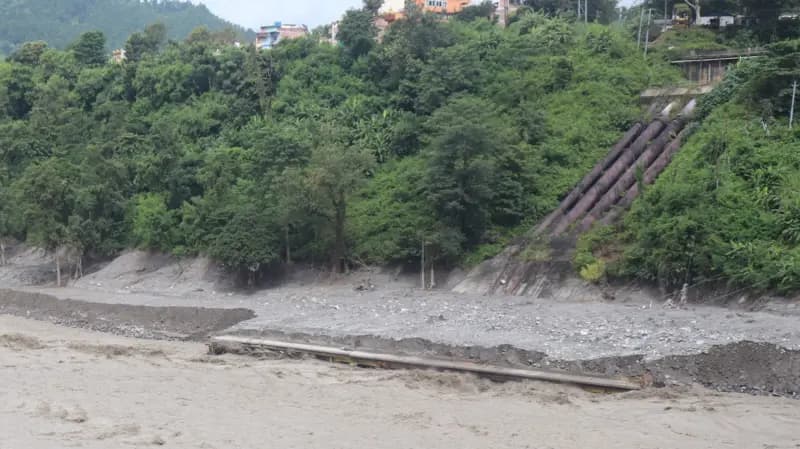
Incessant weekend rainfall and landslides have severed roughly 1,000 megawatts of electricity generation from Nepal’s national transmission system, compounding earlier disaster losses and inflicting an estimated Rs 74 billion in preliminary infrastructure damages.
The latest outages, triggered by downpours between Friday and Sunday, come on top of disruptions from an August 26 flood in the Bhote Koshi corridor that had already isolated over 430 MW. Together, the twin disasters left more than 1,400 MW offline on Sunday, BBC News Nepali reported, citing the Nepal Electricity Authority (NEA).
Speaking to journalists at Singha Durbar on Monday, Minister for Energy, Water Resources and Irrigation Biraj Bhakta Shrestha said the disasters have heavily impaired generation, transmission, and distribution networks, according to Onlinekhabar English. Shrestha noted that roughly 370 MW from projects along the Kaligandaki corridor was stranded after two towers on the Dana-Kushma 220 kV transmission line sustained severe damage. While the minister cited 13 affected projects in the corridor, Mohan Dangi, president of the Independent Power Producers’ Association, Nepal (IPPAN), told BBC News Nepali that the tower collapse forced more than seven plants offline.
The financial toll on the state power monopoly is immense. The Rising Nepal reported that preliminary damage to infrastructure belonging to the NEA and its subsidiaries stands at around Rs 74 billion, according to NEA Executive Director Dirghayu Kumar Shrestha. Key assets, including the switchyard of the newly commissioned 40 MW Rahughat plant and the 220 kV Trishuli-3B hub substation, suffered direct hits.
Despite the sudden deficit, authorities have downplayed fears of load-shedding during the upcoming Dashain festival. NEA spokesperson Rajan Dhakal told BBC News Nepali that domestic industrial demand drops sharply during major holidays, while river flows remain high. Dhakal said most temporarily halted plants and transmission lines are expected to be restored before Dashain, though repairing the Kaligandaki towers may take up to 10 days. The Rising Nepal noted that some plants, including 262 MW in the Seti-Madi corridor and 190 MW along the Marsyangdi corridor, have already resumed operations.
With river discharges bound to taper off later this year, the power utility is already preparing for the dry season. Onlinekhabar reported that the NEA plans to import 1,154 MW of electricity from India between January and May. NEA chief Shrestha stated that domestic generation is projected to drop to 1,218 MW during the dry winter months, against an anticipated peak national demand of 2,272 MW.
To manage winter load in the Kathmandu Valley, where peak demand is projected to rise by 10 percent, the NEA has formed a task force to transfer loads to new substations at Chobhar, Footung, and Mulpani, while charging newly laid 11 kV underground cables and relying on the Kulekhani storage reservoir.