
Floods Inundate Settlements and Block Roads as Heavy Rain Eases Across Nepal
Days of relentless downpours have flooded dozens of homes along the Narayani and Kali Gandaki rivers, triggered a fatal avalanche in Manang, and blocked key transport routes before weather conditions began clearing.
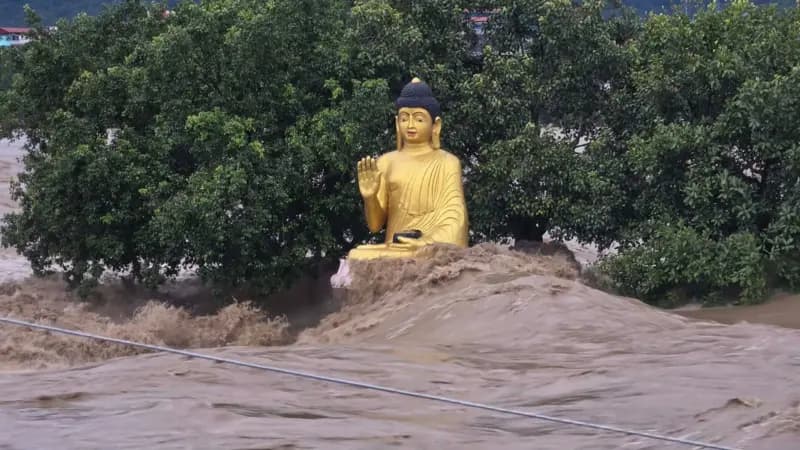
Incessant monsoon rains across Nepal have triggered widespread flooding, river surges, and avalanches, inundating dozens of homes in western settlements and forcing emergency evacuations before weather conditions began to improve on Monday.
Downpours swelling the Narayani River caused water to spill into the Susta area of Nawalparasi West over the weekend, inundating more than 70 homes. According to reporting by BBC News Nepali, Nawalparasi West Chief District Officer Deepak Raj Nepal said local authorities evacuated around 400 residents to safety with the assistance of Armed Police Force personnel, while other displaced families sought shelter with relatives.
In neighbouring Parbat district, floodwaters from the swollen Kali Gandaki River breached settlements in Farse, Jaljala Rural Municipality, washing away 25 homes out of roughly 80 dwellings in the community. Nepal Police confirmed that no human casualties occurred in the incident as residents had been moved to secure ground.
Further north, extreme weather triggered an avalanche at the base camp of the 7,126-metre Himlung Himal in Narpa Bhumi, Manang. Manang Chief District Officer Mukti Prasad Khanal told BBC News Nepali that two bodies were retrieved and flown to Chame by helicopter, while 10 members of the expedition walked down safely as search operations continued.
The widespread disruption followed precautionary emergency measures enforced by the government. Nepal Watch reported that the National Disaster Risk Reduction and Management Authority suspended nighttime and long-distance vehicular movement on key highways across districts marked in red and orange risk categories following alerts from the Department of Hydrology and Meteorology. Landslides and overflowing rivers had blocked major highway corridors nationwide.
Meteorologists noted that the low-pressure weather system centered over neighbouring Uttar Pradesh in India, combined with western disturbances, generated rainfall exceeding 100 millimetres across more than 20 hydrological monitoring stations within 24 hours. Hydrological authorities reported that the Narayani River surpassed its danger threshold of nine metres, cresting near 11 metres on Sunday before downstream risks gradually eased.
Meteorologists Sanjeev Adhikari and Binod Pokharel told BBC News Nepali that the intense precipitation system weakened substantially by Sunday afternoon, making way for clearer skies and sunshine starting Monday.
With rainfall receding, regional authorities have turned their attention toward post-disaster recovery. Onlinekhabar reported that Bagmati Province Chief Minister Kiran Thapa Magar reaffirmed that immediate provincial priorities have shifted from rescue and initial relief distribution to rebuilding damaged infrastructure and rehabilitating families displaced by monsoon flooding, including those hit along the Bhotekoshi corridor. Speaking in Bhaktapur, Thapa Magar said the provincial administration is collaborating with local governments, the federal administration, and private sector bodies to reconstruct critical community infrastructure.