
PM Shah Demands Grant-Based Climate Financing at UN General Assembly
Prime Minister Balendra Shah addressed the UN General Assembly following catastrophic Himalayan floods, calling for debt-free climate justice and a regional resilience pact with India and China.
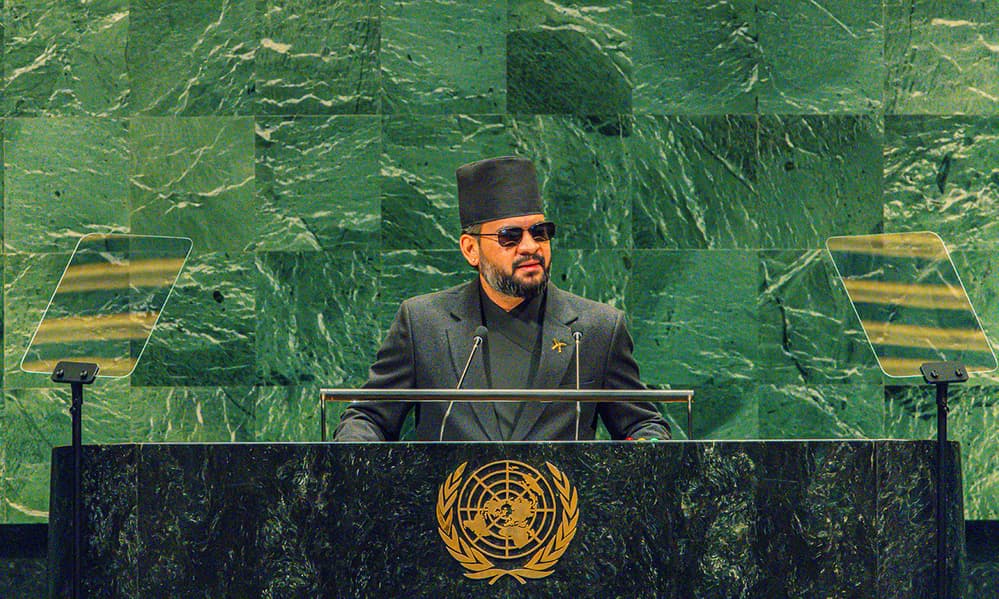
Prime Minister Balendra Shah has urged the international community to move beyond procedural delays and provide grant-based climate funding, warning the United Nations General Assembly that the Himalayan climate crisis poses an existential threat to downstream nations.
Addressing the 81st session of the UN General Assembly in New York, Shah centered his remarks on the catastrophic flash floods that devastated mountain valleys along the Bhotekoshi and Trishuli river systems four weeks earlier. Nepali Times reported that the disaster claimed at least 1,400 lives and left more than 6,000 people missing, with preliminary assessments indicating reconstruction costs could reach 10 percent of Nepal's gross domestic product.
Shah emphasized that while Nepal contributes less than 0.1 percent of planetary greenhouse gas emissions, it disproportionately absorbs the destructive impact of warming alpine ecologies. Proposing a trilateral "Himalaya Climate Resilience Mechanism" between Nepal, India, and China, he urged immediate regional coordination, joint glacial monitoring, and shared satellite intelligence. Shah argued that assistance after extreme weather must not saddle poorer countries with debt, demanding six foundational actions: relief, rehabilitation, reconstruction, responsibility, reparation, and resilience.
The address drew immediate attention for its unconventional delivery. A rhetorical analysis published by The Kathmandu Post noted that Shah bypassed traditional diplomatic formalities to present a direct, human-centered appeal. The commentary highlighted striking contrasts within the speech, pointing to Shah's remark that the world possesses seamless logistical networks for warfare while tolerating fractured systems for food distribution. The analysis also observed that although Shah referenced his standing as the assembly's youngest head of government, he deliberately shifted attention back to systemic international inequality rather than his personal profile.
The global spotlight stood in stark contrast to the start of Shah's diplomatic mission. According to Nepali Times, the prime minister left Kathmandu on a standard commercial flight with a minimalist delegation of four aides and avoided customary ceremonial sendoffs. Despite this understated departure, hyper-partisan activity quickly emerged online. Supporters and unverified accounts circulated fabricated media and synthetic images falsely showing lavish motorcades and fabricated high-level receptions on arrival in the United States.
Domestic scrutiny around the visit also centered on financial expectations. An open letter published by Ukaalo prior to the address called on Shah to propose a $200 billion climate compact running through 2050 to cover verified environmental losses and funding gaps. The outlet urged the administration to complement overseas claims with internal policy changes, including legal guarantees for non-resident Nepali investors, streamlined regulatory hurdles, and long-term urban planning that relocates vulnerable communities out of hazardous river plains.
Shah concluded his address by warning that existing financial channels, including the Loss and Damage Fund, remain severely underfunded and overly bureaucratic, urging industrialized powers to fulfill binding climate obligations without forcing devastated societies into protracted administrative paperwork.