
Marsyangdi Flood Threat Recedes as Blocked River Resumes Flow
Displaced residents in Manang returned to their villages on Monday as an artificial lake formed by a landslide-blocked Marsyangdi River receded, lowering flood alarms across the river corridor.
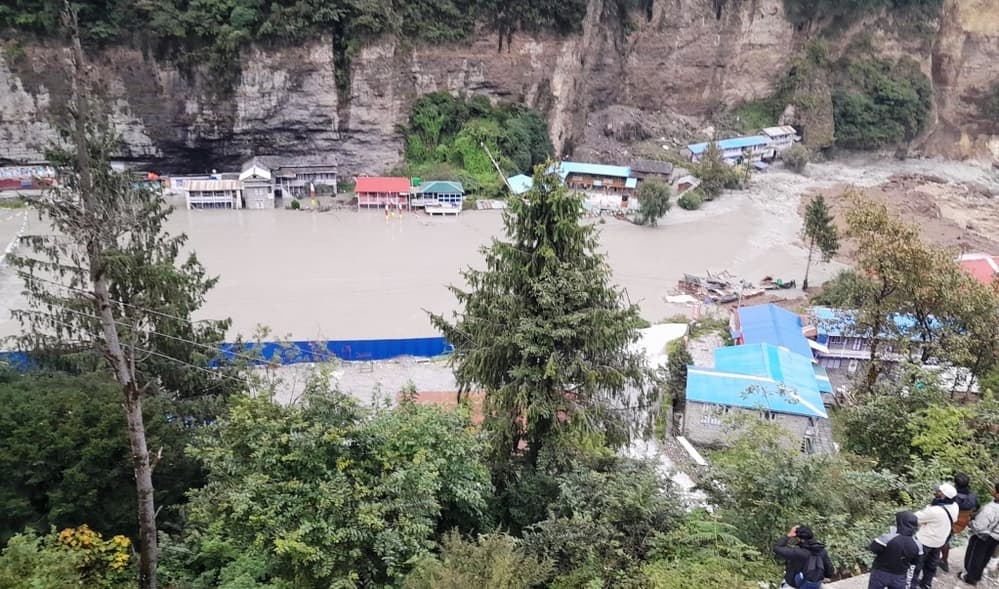
Flood risks along the Marsyangdi River eased on Monday morning as an artificial dam created by a landslide in Manang partially cleared, allowing evacuated residents to return home and assess property damage.
The blockage occurred on Sunday afternoon when debris, mud, and boulders washed down the swollen Ghatte Khola in Chame Rural Municipality, partially choking the Marsyangdi River and impounding a lake upstream. The incident triggered urgent evacuation warnings across Manang and downstream into Lamjung.
According to The Kathmandu Post, displaced families who spent Sunday night in caves and temporary forest shelters began returning to their homes on Monday as weather cleared and water levels receded. Police Inspector Binod Bohara, acting chief of the Manang District Police Office, told the outlet that water trapped in Chame had begun subsiding and a previously submerged bridge was visible again. Manang Chief District Officer Mukti Prasad Khanal stated that the impounded lake level dropped by roughly one metre compared to Sunday, enabling the river to carve out a wider drainage channel, though debris remains a lingering hazard.
Downstream local authorities had mobilized emergency measures on Sunday evening. Nepal Watch reported that Lamjung Chief District Officer Krishna Prasad Khanal ordered the Nepal Police and Armed Police Force to broadcast sirens and megaphone alerts directing riverbank communities—including Khudi, Bhakunde, and Paudi—to immediately move to higher ground. Downstream power stations took precautionary steps: operators halted electricity generation and opened all floodgates at both the 70-megawatt Middle Marsyangdi and 50-megawatt Upper Marsyangdi hydroelectric facilities, while workers along the river corridor were ordered to safe areas.
By Monday, the situation gradually stabilized, though extensive infrastructural damage has left parts of the region cut off. Lokpath reported that residents sheltered in public buildings and Nepali Army barracks had also returned to their villages. However, Nason Rural Municipality Chair Lokendra Bahadur Ghale told Lokpath and Nepal Watch that four days of relentless downpours had collapsed roads and knocked out local electricity and telecommunications networks, leaving communities isolated.
Flooding and bank erosion damaged houses, trail corridors, and bridges in Chame and Nason, including damage to settlement infrastructure in Tal Bazar along the Manang-Lamjung border. Manang authorities noted that discussions are underway to deploy excavators to clear residual landslide debris once road connectivity is restored, with officials advising riverside communities to remain vigilant.